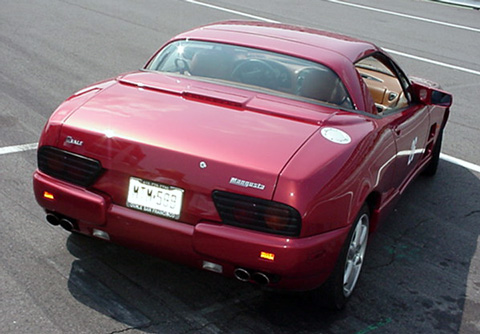
“And here’s another fine mess you’ve gotten me into…”
A tale of intrigue from the 1990s
By Wallace Alfred Wyss
Back in the 1960s, when mid-engined was becoming all the rage, Giorgetto Giugiaro, then a designer at Ghia, penned such a car for Iso Rivolta.
Not that Iso, a car builder making sports cars with Chevrolet and Ford V8s, wanted the car. The owner of Iso, Renzo Rivolta, liked front-engined cars. He had no intention of making a mid-engined car.
But his two top engineers, Dallara and Bizzarrini, did like mid-engined cars and hoped they would talk Renzo into it once he was knocked over by its beauty. It used styling elements from the Iso Fidia, a four seat, front-engined car that Giugiaro had already designed. But Rivolta said “no” in a way they could understand and Alejandro de Tomaso, at the time owner of Ghia Carrozzeria, picked up the design himself to use as a Ghia show car. He put it on a backbone chassis he had designed for a race car he was building with Carroll Shelby until Der Snakemeister dropped out of the project.
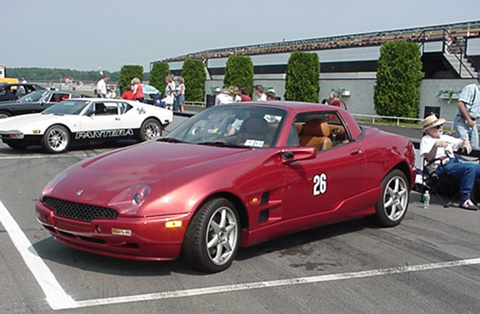
The car, if it was really styled by Gandini, will not be remembered as much as his Countach and other Lamborghinis.
The result was the mid-engined Mangusta, which soon went into production. While the 302-cu. in. Ford powered version that came to the US was anemic compared to the car’s potent looks, the car is still revered for its purity of design. Few production cars look so much like the prototype.
Flash forwards a few decades to 1996. De Tomaso rolls out the Bigua prototype, a front-engined car using more than a little Ford Mustang input including the engine and transmission. The chassis was a box section steel chassis and the suspension independent all the way around.
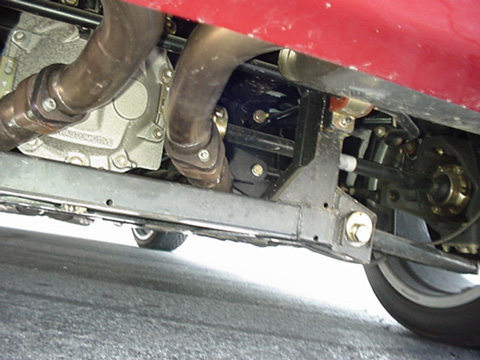
Independent rear suspension and a steel box section chassis made the Qvale handle.
The designer credited is Marcello Gandini, famous in Italy for doing the Miura (although Giugiaro hints he designed that at Bertone) the Countach, and many other Lamborghinis.
It is a blunt car, somewhat reminiscent in general shape of the Trumph TR7/TR8 and its only claim to uniqueness is a unique top that rolls up out of a well, similar to the top in a roll top desk.
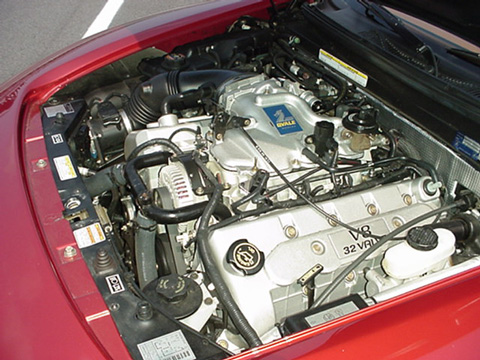
The best thing about the DeTomaso/Qvale Mangusta is that you can obtain engine parts at any auto parts store in America–a similar advantage by those who own Jenson Interceptors, Isos, and Monteverdis.
The engine was a 4.6 liter Ford V8 a quad cam version also used in the Mustang Cobra. It was a lot more powerful, at 320 hp than the 230-hp the 302 used in the original mid-engined US spec Mangusta. (Another source lists the Ford 4-cam as having only 305 hp.) The Mustang engine had 314 ft-lbs. of torque. Transmission choices were a Borg Warner 5-speed manual or a computer controlled 4-speed automatic. Gas mileage was 17 mpg in the city and as high as 28 mpg on the highway.
de Tomaso was showing it around when who should call but Kjell Qvale (pronounced SHELL QUE-VOLLEY) a Norwegian who had built an import car empire in San Francisco. You might call him the “King of Van Ness Avenue,” San Francisco’s new car row. It was Qvale who, back around 1968, had bankrolled production of 280 Mangustas the first time around, selling that number in the US. He established the De Tomaso marque enough for Ford to take notice and soon after Ford tied the deal with De Tomaso to import the Pantera, leaving Qvale, his first US importer, out in the cold.
Qvale arrived in the U.S at age 10 in 1929. He was later to see service in his adopted country as a Navy pilot and soon after the war was importing Jaguars later Rolls, Bentley and a number of other expensive imports. He formed British Motors in 1947 and made a lot of money and to top it off, he was one of the first Volkswagen dealers.

The grille was an attempt to have a perforated sheet similar to what Land Rover does now, but not done in an expensive looking way.
Flash forward again. Qvale saw the De Tomaso Bigua as a car whose costs he could control, reasoning that it had an off-the-shelf Mustang V8. Of course his first move was to rename it the Mangusta in honor of the late, great mid-engined DeTomaso of the sixties, which was a pretty smart move. With his sons and De Tomaso, they formed a new company and opened a new factory in Italy to build the car.
Almost immediately the deal fell apart.
In the year 2000, according to Chris Gable, a writer for a website called Drive.com, the two companies split apart and the car was renamed the Qvale Mangusta. Qvale told this author that de Tomaso was impossible to work with, reminiscent of the time that Ford tried to get him to straighten out flaws in the Pantera only to find out that, once he had an investor, he felt no responsibility for gliches in the resultant product. De Tomaso was always off to the next project.

The top was ingenious–it rolled up into place like the lid of a rolltop desk.
The Qvale Mangusta had one unique styling feature called the “Rototop,” actually a three-position roof that converted the car from coupe to targa to roadster. Qvale put one of his sons, Bruce Qvale, president and CEO of the Qvale Automotive Group, in charge of the newly named car and the agreement with deTomaso was scrapped.
The original licensing agreement gave Qvale the global rights to manufacture, distribute, and retail the new Mangusta and all future DeTomaso-branded vehicles … except, according to writer Gable, “in Italy and the UK. Once DeTomaso was out of the picture, Qvale could go after those markets.”
Manufacturing cars as well as selling them was not a new idea to Qvale. In the past the company was making Jensens in England including the ill-fated Jenson Healey and more successfully, the Interceptor III and distributing such brands as the VW Beetle, Porsche, Audi and Maserati in the US. Overall, the Qvale company has moved more than a million cars out the door of American showrooms. All this from a hunch Qvale had after the war, figuring that Americans wanted something stylish instead of the blundering cars Detroit was making. He also funded race teams, even running at Indy with drivers the calibre of A.J. Foyt and Bobby Unser.
But it was with new cars that his money was made. He thought he knew about producing them, as a result of so many years of selling them. As is usual with new cars, once the manufacturing costs are discovered, the price of the car rises to try to keep ahead of that and the Qvale Mangusta was priced at $78,500.

The Qvale Mangusta interior was done by a subsidiary of Ford which was hoping their good job on that would get them lots of business from other automakers. But alas it was a little too much like a Mustang interior to look Italian.
Ford got a little too deep into it, with their Visteon parts division doing the interiors. Visteon later went broke so you wonder if they invested too much in their bid to become a supplier to importers?
The car was a hot performer with a 0-60 mph time of a tad over 6 seconds and a top speed of near 155 mph. Although production was pegged at 500 a year, it turned out to be a lot less and, alas, only a few hundred cars were made, even if you count the original ones branded as DeTomaso. According to one source, “between 2000 and 2002, Qvale built 270 cars (or 272, depending on which source is to be believed), the majority of which were exported to the USA.”
Why was it a failure? Well, first of all it was false advertising in a way, calling it a Mangusta when the original Mangusta was mid-engined. Secondly its styling was Gandini’s worst, not one of Giugiaro’s best. Third, the interior was a little too Detroit-looking to be passed off as hand-made-in-Italy. And the price, well, let’s say it was a smidgen too close to a car like the 500SL that, in terms of quality, was streets ahead. Then, the problem of the name change altered the public’s perception of the car. As a Detomaso marque car it can be shown at concours alongside the original Mangusta, the Vallelunga, the Deauville, the Longhamp, and the Guara, but as a Qvale it’s well…almost thought of as a pretender, a wanna-be, to the bloodline of DeTomaso.
It’s difficult to say now that a decade has passed whether the ones labeled “DeTomaso” are worth more than the ones labeled “Qvale.” We suspect that but, in terms of reliability, one has to expect that the later each car was built, the more chances there were to sort out engineering flaws compared to the early ones badged as DeTomasos.
Qvale, a pragmatic sort, dumped the whole thing on Rover, who produced a very odd looking coupe from the leftovers called the MG SV (Project X80). It was faster but reeked of the Japanese origami School of Styling with a little Transformer thrown in.
Qvale told the San Francisco Chronicle in an interview in 2008 that he lost $28 million making 284 Mangustas.
But no matter. We are talking World Class entrepreneur here. Qvale was always a gambler, for instance, way back in 1963 he bought a horse called Silky Sullivan after he retired from racing and put him into stud, building a thoroughbred horse racing empire. Sometimes he would pay more than a million for a horse only to have it end its riding career within days.
Hey, you win some, you lose some, but the Qvale Bigua, that one hurt


Kia Australia has a range of


{ 4 comments… read them below or add one }
“The designer credited is Marcello Gandini, famous in Italy for doing the Miura (although Giugiaro hints he designed that at Bertone)…”
Hints, my foot! Gandini and Giugiaro have all but come to blows over this, with each pulling drawings and documents out to prove his point that HE and he alone was the sole creator of the Miura. I seriously doubt that they’d be having such a battle over who designed this pitiful thing, however. At least it’s probably got a nice stiff body, unlike the original Mangusta, whose stunning looks were reportedly let down by a sadly inadequate structure.
Out of the 3 constants in life..’the good, the bad and the ugly’ I’m afraid Qvale’s Mangusta died mainly from a large helping of the third.
As a previous owner of a 1970 DeTomaso Mangusta I felt that I needed to chime in on this discussion. Personally I feel the original Mangusta was a very beautiful design and one of my personal all time favorites. I was excited at the time that a “new” Mangusta (the Qvale) was going to be built. However the styling was not to my personal liking and didn’t reflect the qualities of the original. I really tried to get on the bandwagon but really just couldn’t. And after all this time the new design still dosen’t really excite me. Perhaps this is a good car in it’s own right but shouldn’t have had the “Mangusta” moniker attached to it.
Fascinating story and it shows too the determination of Kjell Qvale, a remarkable man in my opinion, to make the Mangusta his baby.
I happen to own a Jensesn Interceptor Convertible second prototype in the UK and this was Mr Qvale’s transport during his days at Jensen – it also served as a Press car.
Do you happen to know Mr Qvales address so that I can write to him and send him some photos of his “old” car?
Kind regards.
George Zdanko