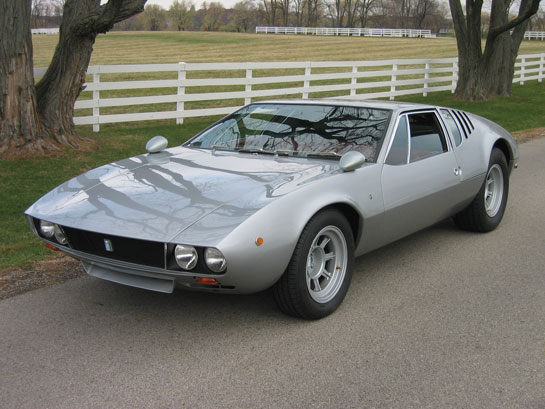
Beauty, interrupted. At its best, pictured here, the Mangusta is a work of art. At its worse...well... Car and photo courtesy Daryl Addams.
Beauty, Interrupted
By Wallace Alfred Wyss
The DeTomaso Mangusta is one of the most beautiful cars ever to come out of Italy. But it does have its problems.
On paper, particularly when you consider that it made its debut in 1966, it seems like a magnificent achievement—it’s mid-engined, it’s low to the ground, it is low in height (42” high) , and is a very clean design.
Actually, and ironically, the body shape was penned by Giorgetto Giugiaro more as a whim—Ghia was doing the Iso Fidia four door sedan at the time and Ing. Bizzarrini, at the time working for Iso, thought it would be a good idea to have a sports car with some of the same design features for rich people to mark alongside their Fidia. Sort of a “his and hers” combo. So a mid-engined Iso was drawn up and a body shell built. But when it was shown to Renzo Rivolta, the owner of Iso, he rejected the idea outright (probably knowing that the only available transaxle would cost a bunch more than a transmission for a front engined car) and Ghia coachbuilders was stuck with a body design they didn’t know what to do with.
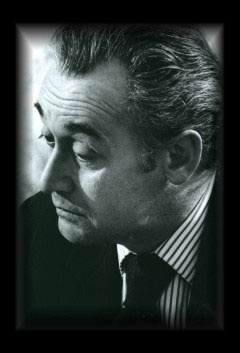
Alejandro de Tomaso in the 1970s.
In 1963, after making a number of mid-engined race cars, DeTomaso Automobili came out with a production four cylinder midi coupe called the Vallelunga, named after a racetrack where a prototype of theirs had encountered some success. Alejandro, it turned out, was crazy about the spine frame. He had seen it on a German prewar car, the Rumpler, and decided it was the way to go. The car was cute enough, sort of a baby Ferrari 250LM in styling, but not nearly fast enough with its slightly hotted-up British Cortina engine.
A Vallelunga vintage racing today. Photo by Alessandro Gerelli.
Around 1965, DeTomaso had also been doing a project with race driver Carroll Shelby, a sort of Can Am car powered by a hyped up 289 V8 (which DeTomaso claimed produced 500 bhp, which would have been a surprise to Shelby, who had seen them grenade at 390 hp.!) But Shelby at some point yanked the funding on his part, because Ford wanted him to build more Daytona coupes for the Cobra racing program. So DeTomaso was left with a beautiful spine chassis but no money to develop it into a race car.
So there was DeTomaso, who had bought the aging Carrozzeria Ghia with his wife’s family’s funds, with a body that no one wanted. (See note 2)
Since the 70P car was defunded by Shelby, DeTomaso said he owned it. He thought about what to do with it and decided to mate the Guigiaro-designed street car body on the mid-engined 70P spine chassis developed from the Vallelunga. That became the Mangusta. He named it the “Mangusta” precisely to pique Shelby because, in nature, the natural enemy of the cobra snake is the mongoose, i.e. mangusta. Also now today the name of an Italian helicopter and a huge superyacht.
DeTomaso had only planned on the Mangusta being a promotion item for his shop, it even being called the Ghia 5000 in the lettering on the tail, but those customers with checkbooks in hand were not to be ignored. He started production of the Mangusta body shells, most likely on a chassis made elsewhere.
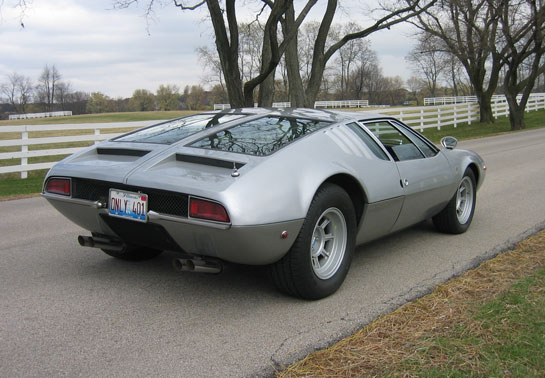
The license plate refers to the total number of Mangustas made, which , considering DeTomaso's sloppy record keeping, could be hundreds of cars off. The exhausts have quite a bark since they aren't very long. Photo by Daryl Addams.
Though DeTomaso was going full speed ahead on the Mangusta, there was a fly in the ointment—the car failed to meet a myriad of new design laws in the USA (headlamps too low, toggle switches on the dash, no crash protection, etc) but DeTomaso’s in-laws were what you call “connected” with American legislators. (We would say “in bed with” but don’t want to risk mis-interpretation through double entendres) DeTomaso squeaked the Mangusta through for U.S. sale by having it exempted as a low volume car, of which less than 500 would be made and only through 1969 in its original form. The idea was to sell the non-conforming cars and then update the model to meet the laws in 1970. And that’s what they did, the 1970 Mangustas having pop-up headlamps and rocker switches on the dash among other up-dates. (On the cars with two headlamps when the headlamps weren’t flipped upright, they looked odd, and droopy which is why some prefer the four headlamp cars. Giugiaro used a similar flip-up headlamp design on the prototype street Iso Grifo and later long-nose Iso Grifo production cars.) If you see an early Goose it usually bears a little silver ten cent stick-on label that says that it is exempted from a whole raft of U.S. regulations. They might have just as well stamped it “politically protected” or “We know someone in Washington D.C.”
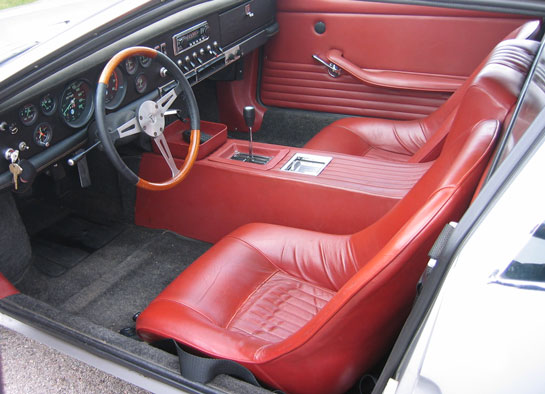
The steering wheel was unique in that it used leather and then wood sections. Car and photo courtesy Daryl Addams.
You would expect a prototype to be test driven hundreds of thousands of miles while being developed. While DeTomaso did hire accomplished race driver Jonathan Williams to do some testing, it was probably under 3000 miles and likely little Williams said was to have any effect. The Mangustas were in essence, hand made, each car a little different.
Now comes in a wrinkle: a woulda, gooda, shoulda. The head designer at Ford, one sharp eyed martinet named Eugene Bordinat, took a fancy to the ‘Goose and ordered one. Ford even had it painted yellow and displayed at the New York Auto Show. If you were there, and inquired, you got a brochure advising you to make further inquiries of Mr. Carroll Shelby, yes, the same ex-chicken pluckin’ Texan that DeTomaso was making fun of (the auto biz makes for strange bedfellows….).
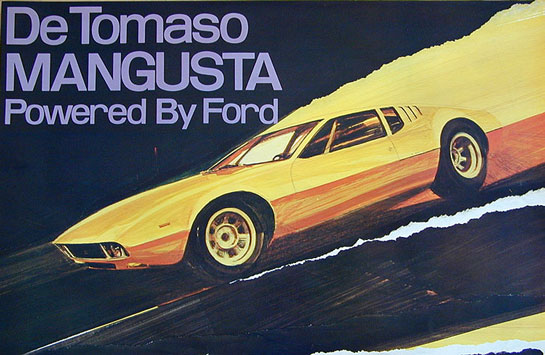
On the occasion of Ford showing a Mangusta at the NY Auto Show they handed out this poster, which was probably by George Bartell. It referred interested prospects to one Carroll Hall Shelby.
But when a Ford engineering and design team were sent to inspect the cars being made on the assembly line at Ghia they came back shaking their heads that such a modern looking car was in fact built crudely, along the order of Cobra bodies which Shelby always said “were knocked out by winos under a bridge.” The Ford minions raised DeTomaso’s hopes, then dashed them. But ironically, in the manner of a true salesman, DeTomaso collared the executives before they left and showed them five wooden scale models of a new car, the DeTomaso 351. This one, he explained, would be unitized. No more spine frame. Furthermore, it would be made on an assembly line, just like in Dearborn. No more hand made body panels, etc. Plus he had this assembly line in hand in another coachbuilder he had added to his portfolio, Vignale. They were a company with a rich and storied history, and had last been building the Maserati Indy.
Timing in the car business is everything. DeTomaso, a LeMans racing veteran, had observed the seduction of Henry Ford II, grandson of the first Henry Ford, into the world of Italian cars. Henry Ford II was in fact going through sort of an “Italian period” at the time. Even though the Ford GTs had vanquished the Ferraris at LeMans not once but several times, he still hankered for a Ford to be made in Italy. An exotic Ford, one that people would look at and think: “Is that the latest Ferrari?”
So it was that he had issued orders to his minions to come back from Italy with an Italian car. So even though not a single Pantera had been built, and there was no prototype to drive, they bought the Pantera before they left town.
Note 1
He bought Ghia from Leonidas Rhadamés, the young son of Rafael Trujillo, the dictator of the Dominican Republic. It is said that young Trujillo was in jail at the time so most amenable to any cash offers. You might think the son of a dictator would have some political clout but it is said a CIA-paid for bullet put that clout to an end in 1961.
Note 2
DeTomaso happened, by accident or design, to marry into a monied family bulging with entrepreneurial zeal. The wife’s father once started a horse racing track, Monmouth Park and was a GM VP. They got married in Palm Beach, always a sign that you’re in the money. At first the Haskell family kept DeTomaso away from the family coffers but eventually they couldn’t resist getting into the car business, their money coming in at about the time of the Mangusta program.
Next week, Part II.
You state “but DeTomaso’s in-laws were what you call “connected” with American legislators. (We would say “in bed with” but don’t want to risk mis-interpretation through double entendres) DeTomaso squeaked the Mangusta through for U.S. sale by having it exempted as a low volume car, of which less than 500 would be made and only through 1969 in its original form”
In fact the Federal Motor Vehicle Safety Standards specifically allow non conforming vehicle manufacture UP TO 500 copies as long as the Fed is apprised of the non conforming sections. There was no `funny stuff’.
No Mangustas ever had rocker switches ,save the left and right rocker switches for the electric windows.
More opinion and vitriol than fact in this article; not up to Veloce Today’s standards. And in fact the 500 car exemption from safety regulations applied to all imported models made to Dec. 31, 1969. I know; I was deeply involved with a Morgan at that time.
The following comment is from reader Dick Irish who needs no introduction to these pages. We edited Dick’s email down to a reasonable length and posted it.
Loved the Mangusta bit. Mind of I indulge in a couple of comments?
First of all I never knew of Isabelle’s W. Crapo Durant connection. I knew she was from Red Bank, N.J., her brother drove a 300SL and she had GREAT… oh, never mind! I thought a lot of her and really enjoyed our Sebring stint!. Haven’t seen her since one noon at Papa Cantoni’s ristorante in Modena when I was picking up my Ferrari 275 GTB/4.
While at the ’67 Turin auto show I got my first good look at the Mangusta and had a nice chat with Alejandro. Never forgot his comment, “Dick(he says) What is wrong with you people? You make us put lights on the car to show where the lights were before you hid the lights!” He referred in particular to that “W” grilled Buick with the lights in the grill and hidden from the side by the leading edge of the front fenders!
When Toly Arutunoff and I were back for the ’68 Turin show, Isabelle and Alejandro had left word for them to let us “test drive” a Mangusta. Toly had a “go” first and when he got back I had my chance. As we left the “works” the test driver looked at me and said, “You don’t remember me?” I told him I was sorry but I did not and he replied, “Last year I worked for Scaglietti; I put the roll bar in your car.” I gathered the car was squirrely because ever time he’d look down the road and see a damp spot (there bad been a few showers), he would lean up and point ahead saying “Wet! Wet!” so I’d ease off. He directed me over to the Autostrada and I asked him how high I could rev it as it was a brand new car with new engine and the tach was red-lined at 6,500 as I recall. His reply was “6,700”! When he verified this, I thought to myself, “Only in Italy!” On the Autostrada I was impressed as we hit the 6,700 in 5th in what seemed like nothing flat and had to lift a tad. We were approaching a tunnel when two Fiat 500’s pulled out nose to tail to pass a couple of slower trucks while we were going full chat. I flashed the headlamps as I jumped HARD on the binders and grabbed 4th, then third and second. It was sort of hilarious because as we bore down on the trailing Fiat I could see this driver’s eyes like tea cups in the mirror as he knew he’d committed a cardinal sin in Italy! We literally got anchored just a matter of feet off the rear guy’s back bumper as they were pedaling for all they were worth. The test driver exhaled and gave forth a, “Va bene!” That compliment made my whole darned day!
I actually had a twinge about selling the 4-cam for the “convenience” of a Ford in the DeTomaso. Fortunately I did not succumb. I still did not know how reliable that 4-cam would be as I only had about 35,000 miles on it that first year.
Thanks for “the ear”!
Dick Irish
Wally Wally Wally!
You say the Mangusta has it’s problems, and then you say literally nothing about the car….yet loads on it’s predecessor and it’s follow on model…..
While the car had “issues” that all Italian cars of the era had, lousy rubber anything…be it belts or hoses, built in paint issues in many cases…and it had a poor weight bias…..(hey! it’s a GT car, not a race car!) , the car really is a very sound piece once you get the things updated that should be updated! (Certainly if you haul one of these out of a barn somewhere and attempt to put it back on the road!) Rubber bits, hydraulic hoses/cylinders, discharged gas shocks, power window gears, and tires basically!
I believe these cars suffered more at the hands of incompetent mechanics than anything else. Due to it’s “Heinz 57″ combination of parts used to build it, service parts are remarkably easy to come by even today! When sound mechanics and parts are applied to these cars, they run very nicely and are extremely well mannered out on the roads! Very comfortable ‘at speed”, but then I’m only about 5’8″. Much taller than this, and you are looking at having to drop the floor pans, or adapt an unusual posture while motorvating down the road!
Wally, I expected a much better article about the CAR, not the man and his wife’s adventures……you’ve seen enough of them….perhaps you need to drive one!??? See you at the next US DeTomaso love-in 2011????
Steve
PS: Yes the AC unit is also under powered….but rotary compressors are cheap these days….and add more squirrels in the fan cage area!
Yes, a bit more about the car itself would have been nice, but was fun to hear the gossip part of ‘the story’.
I’d (almost) die to have a Mangusta. In the 60’s I was at Caldwell Tires in Pasadena having tires installed on my 750 Double Bubble when a fellow drove in with a brand new Mangusta. He was kind enough to lift the rear panel so I could see the engine and transaxle. I was smitten with it.
I’ve heard horror stories of 50’s and 60’s Italian ‘supercars’ and what was found under the paint when they were being restored. You want Germans to build Italian thoroughbreds? Oh yeah, forget I said that.
Since I restore Alfa’s, mostly older Spiders, my take is, “So the Mangusta needed a little more sorting out…what’s new.”
At the heart of the Mangusta’s problems was the backbone (not ‘spine’) frame. This was just way too weak in torsion to be subjected to the stresses of a powerful car like the Mangusta. Colin Chapman found this out with his use of the same concept for his Lotus 30.
But is it ever gorgeous! I love the gullwing openings over the engine.
What about the transaxles being damaged going over railroad tracks? No one remembers that problem.
Hello from Spain..
how exactly does the chassis work? are the rear suspensions connected directly to the engine? (engine acting as part of the chassis) I think this could be a first for a production car…
Wally,
Love the article even if it’s a bit sensational beyond the practical. In other words, written like an Italian car is built!
The Mangusta, along with the Pantera and various other Italian cars of the late ’60s to early ’70s, has some of the most stylish Campagnolo alloy wheels ever put on an automobile–modern designs leave me pretty lukewarm by comparison. Walking around Concorso in Monterey I overheard more than one admirer saying something about the, “Campy mags on that Lambo,” or the like. To the best of my knowledge, Campagnolo never made magnesium wheels; they’re actually Ergal, a brand name high-strength aluminum alloy incorporating 4% copper (among other alloying agents) that aids forging as well as fracture toughness–an important property, safety-wise, in auto wheels. The same alloy was used in Campagnolo bicycle components from that period, including the iconic Nuovo/Super Record gruppos.
Campagnolos were made from a magnesium alloy called Elektron, they made wheels for many European cars, from Ferrari and Lamborghini to Volkswagen, and even some Japanese cars, such as Datsun 240Z! FAZA was the exclusive importer for many years, and last I heard, Al Cosentino still had NOS Campagnolo wheels for many European cars. They are really beautiful and considered “ultralight” in wheel parlance.
This article is in error about the DeT 351 (later Pantera) scale models shown to Ford–there were three of them, not five. And the “long-nose” Iso Grifo was done after Giugiaro had left Bertone (and Ghia, too, for that matter).
To Medved: It sould be,”…of which ‘fewer’ (not ‘less’) would be made….”
Well,here in Italy,De Tomaso cars never got high ratings overall talking.
This was mainly due to their USA engines… that was the only way to go if you had to power a big Gt car chassis though :those big Ford and Chevy blocks provided decent performance along with trucklike reliability at an affordable cost.
But,this said,Alejandro’s cars were true beauties and the Mangusta,when seen cruising through our towns did overshadow every other contemporary sportcar.
Alas,as a bad all italian habit we were used to, back then,customers felt as having been scheduled as post production factory-testers by GT cars producers (all included to be honest).
Nontheless,notwithstanding the absence of noble mechanics,DeTomaso cuties had just the same amount of downlights as their challengers on the market,most of them coming from a poor (if ever done) testing time before rolling out the factory’s gates and from the hand made job which needed,again, a longer and more accurate check up by the tech.staff.
On my humble op. there’s actually one massive weak point,objectively coming from the project itself: the short wheelbase made the car pretty nervous on the wet.At least that’s what I was told in several GTcars shops where I had my 911s serviced:regrettably I have no personal experience. Today,a different set up in the rear axle supported by a far better tyre’s grip could reduce the problem…not so sure they could be able to successfully fix it in those years.
Speaking as a Mangusta owner and a mechanical engineer, the spine chassis may have issues, but the far greater problem is with the tube chassis from the firewall back. The original P70 racing chassis hard bolted the engine/transaxle to the spine chassis and mounted the suspension on the engine/transaxle. Contrary to what many of the books state, the road cars were completely different, using a frame of square tubing welded to the spine and extending backward to mount the engine/transaxle and suspension. This frame is often described as a “space frame”, but is nothing of the sort. It is more of a parallel tube frame consisting of 4 rectangular longitudinal tubes of the relatively wimpy size used in those days (look at the tubing used in a modern rear engine Ferrari and you will see what I mean). The upper and lower tubes on each side are triangulated to each other more or less reasonably with round tubing, but the two sides are connected only by a rear cross member at the bottom and a bolted in cross member at the top. The result is a flexible flyer chassis lacking stiffness and prone to cracking. One can just imagine deTomaso telling Dallara: “No you can’t redesign it, just finish it up the way it is so we can sell some cars”. Later Mangustas have strenghening fillet plates welded into the frame, a change which helped but really didn’t solve the basic problem.
From: Dick Ruzzin
This comment found on the internet , with sound references disputes Wally’s comedy routine. It is apparent that articles like Wally’s perpetuate the myth with
a lack of real factual information. Media is responsible for most of the erroneous “facts’ about the mangusta.
Dick Ruzzin / junkinthetrunk
_________________________________________________________
April 29, 2010 at 8:17 pm 0 or Flag comment
I’ve said this before somewhere else, …. but i’ll say it again.
Go read the 3 part series (stage 1, 2 , & 3) in 1969 Sports Car Graphic Mag. (you can find copies at Mangusta International ‘ s website). The main problem was the standard issue tires.
But besides this , on the same website (or if you have it in your library ) read the Nov. , 1969 Road & Track article – “Around and around we go to find out about CORNERING POWER” (starting on pg. 24).
9 cars were compared on a skid pad :
Lola / Ford Group 7
Detomaso Mangusta
Corvette 427
Porsche 911T
Lotus Elan S4
Dodge Charger 426
Alfa Berlina 1750
Chevrolet Impala
Austin America
And guess which came in 2nd best ?
The Mangusta
And that was with the stock tires – sporting the WORST tire contact patch area of them all, AND the six from the best in tire width !
Granted there were some pigs out there but it beat the Porsche & the Lotus !
Imagine the differance with modern tires and some suspension work.
Even in 1969 , with changing to Goodyear polyglass 60’s – Sports Car Graphic got one to handle great (again read that 3 part series).
Bad handling – just a bunch of incorrect ‘lore’ , handed down mouth to mouth (and in print) from some original unexperianced magazine testers opinions . Testing on the stock tires & badly set up original suspension settings.
Granted in earlier April 1969 Road & Track in their road test said “Tricky Handling” . But again stock tires and suspension setting’s AND they were comparing it to a Muira’s handling.
There is other Mangusta information passed down over time that even most Mangusta people don’t know. It was just initial Detomaso plans that were never actually followed through with. Just magazine writers rewriting wrong info. again & again over the years , and people believing what is in magazine print.
People like Wally Weiss.
Funny story involving a Ferrari 275GTB/C and a Mangusta. I was the President of Peter Gregg’s MB+BMW dealerships in the 1970s. My friend Pete Stanford was a contractor in Atlanta had a 275GTB/C, #9041 if you care, but wanted to go racing and had bought a Mangusta and was convinced that because it was a mid-engined car it had a BIG advantge over those silly rear engined RSR Porsches. He needed the money to develope the Mangusta so sold me his 275 and ploughed the money into the Mangusta for IMSA GT racing around about 1975 or so? I warned him that he could buy an RSR from us(Brumos)for I think around $40K with spares and that every proven race part was available over the parts counter! No way he said and proceeded to try to race the Mangusta and over the next two years broke every un- proven miserable part on the Mangusta and as I reacall never finished a race and finally broke and tired dumped the car for peanuts! Today the 275 which of course I sold too soon around the late ’80s is worth maybe $3.5M and the Mangusta maybe a $100K and the RSR if he had taken my advice is worth maybe $250-30oK
I drove the Mangusta a few times in testing and it was awful, slow and didn’t handle with too much rear weight and not enough brakes! Tom Claridge
As a long time Mangusta owner (8MA 520) and long time race driver, I personally doubt the Mangusta chassis has any real issues. It’s all repetition based on flawed assumptions. I run my car on the road on the prototipo-spec M-section Dunlop Racing tyres (much wider at the back than the front) and it feels pretty good. It also gives the car the right ground-clearance that is often messed up by the wrong size of tyre, and the potential to get to a true 250km/h in terms of gearing. It looks dead right too, filling out the arches properly & putting a decent footprint down on the road. Handling-wise, the car rotates around it’s own axis as a mid-engined car should, although given it is a 60’s cross-ply tyre design, relatively low grip levels. Mine is a HiPo 289 (yes, they really exist in early cars) and it easily outguns our Ferrari Daytona, although might not have the top-end or aero stability, as the Daytona is a very sorted car at speed. On a track, the brakes of any car of this period would give up, but on the road they work very well. Back in the 80’s my father even raced the car in a classics event at Kyalami & he too thought it pretty reasonable. As a classic for the road, I think it is very usable as is, and perhaps it should be about experiencing the car as it was produced, within it’s limitations. Two things though: the engine cooling is marginal in traffic and before I widened it, the sump held frighteningly little oil. For certain it would need extensive development for serious competition work. Above all else, it’s a design materpiece up there with the best of the 60’s supercars in terms of drama and proportion.
Of all the people, writers, engineers and other professionals involved in all the tests on the Mangusta no one figured out the weakness in the Mangusta chassis that can cause almost instantaneous rear camber change. It is there in plain sight when you open the engine cover. The rear subframe top section called the “bridge” is attached at each end by a single bolt through a rubber bushing, the ZF is solidly mounted to it. That allows the rear wheel upper force input while cornering to cause increased camber on one side and decreased camber on the other. If the small rubber bushings are in good shape, like new, the weakness probably is minimal. Philosophically the rear structure is very much like the GT 40 but the execution is very different.
The bridge as a frame component is set up backwards. The ZF should be soft mounted to the bridge and the bridge should be solidly hard mounted to the frame, completing the integrity of the rear structure, like every other mid-engine car.
The Mangusta and the Miura both have the same weight bias. A solid subframe Mangusta is a completely different car in its ride and handling and with good shocks and tires it gets very close to DeTomasos original intent as stated in the owners manual.
DICK RUZZIN
DICK RUZZIN
DICK RUZZIN
I owned 8MA-ll48, put 10.ooo miles on Her…a 70,, with toggles on the panel, so that’s inaccurate and yes my car was a bone stock windsor 302 as all US export cars were, however it is said there were only about 50 of cockroach headlight cars built..all US export cars…mine had em and i butched them into nacelle, plus i did triangulated box tubing up front, supporting body off frame horns better..deTomaso cranked out prototypes cuz He was broke..pure & simple…no real R & D program because, sshhh….He WAS BROKE!…Ford came back with a no on the Goose because of politics and favoritism, just the way the Howard 500 was killed by feds working in grummans favor, eliminating competition for the G-1…..the Goose in it’s essence has all the right shit, it just had to be sorted out properly, which today is all figured out and fixes available…the biggest issue causing the spooks in the ass was a brain fart in hanging transaxle…takes about 500.00 in fabrication to cure it…Mark Donahue was so full of shit when He made claim….”the rear roll center of car is too high”..Well Mark was too f-ing high. People can postulate all they want about the car, not many “experts” have ever lived with one…my car started ever time i turned the key, yes it was dangerous in a fools’s hands….extremely, but it is it’s own universe….i’ve owned and driven a well varied amount of muscle, sports, exotics and i am a hard ass to follow in anything….there is NOTHING like a Mangusta end of story. Not fast in it’s stock undeveloped form, but so beautifully wicked to drive, long ass third gear with the ZF whining, and spinning in one is a sensation next to none today a few campaigned quite successfully here and europe..the Mangusta can now kill a lot more than a pick up truck AC Cobra. Production of the Goose was to sketchy to try and trace where what was added or deleted…the first couple cars had operating vent windows..the first few had the gill louvers in wings open intakes to feed air towards dear of car where the hose inlets were that led to air cleaner, the louvers had to have very complex water drainage systems that He had to drop from production because of that evil shit money. There was a 67 with open louvers, built for GM’s Bill Mitchell and had a factory installed, special “Zora” prep, Corvette 327 installed…because the rocket scientists @ GM forgot to remove the shipping clamps from coils, Bill rejected it after one lap because of no ride and He was just too big for car, an employee, engineer named Dick Ruzzin purchased car…He put over 60.000 on His clock before recently selling, so if you want the best dope possible on a Goose, talk to Dick…in 2010 He isolated the mounting problem with transaxle. Yes the car had many imperfections, but some of them are also what make the car so perfect, it’s an outlaw, an Enigma that DOT played ball, when else has DOT ever allowed a prototype to be openly sold? No average car kids…it has a Soul. So single beams were strictly US export and probably only 50 of 401 hand built cars, and the toggle switch thing must be half myth because again, my car was a 70 with togs. my Brother had a 69 w/ singles but had a non matching 8500 rpm Boss 302…mine had a ford windshield wiper motor, His had a Saab wiper motor….they were all Fiat 124 spindles ,bearings, & ball joints. door handles and tailights were Fiat 850….Gary Hall told me He had one(back in 79) that one clamshell/wing was alloy skin(the norm), but one was fiber glass, Knowing about a car, driving it a handful of times is all good, but You don’t KNOW that car intimately, that takes time, for it’s ills, the Goose is a vault of sublime reward…and NOBODY will EVER OUTDO tTHAT POSE…..NEVEEER!!
Guess i should have read the comments, Speak of the Devil above me, Dick Ruzzin, You are my Hero Man…Andrew Jackson killed the Bank and You saved the Goose!! Shocked me to hear You finally let Her go. In relation to Richard Sorenson above speaking on little oil capacity….yeah i burned up main bearings pretty quick because of no windage tray and always practicing spins…i did learn my car well, sure do miss Her, hasn’t surfaced. jimi buff-it
RSR brumos guy…Mangustas are in the mid range of 200K now..actually 180K is about the liowest unless You find some burnout…One sold last Year at bonhams for 332K….and no matter how quick vs not ,the porch is STILL a production car, just f-in rewerked, sramped panels.. it lacks the exquisitness of an artistic statement…the goose has all of that, few numbers,……….. any body can have have a porsche’ There’s an f-in plethora of the german bitch wagens around….THAT is the difference babe! You need to update a little boscoe see 8MA-580, or the Sunspeed Car…tear an rSR to bits….where was the funny story?
Winks has it wrong, the lowest point of car was oilpan and Magnesium Bell housing….could not drag ZF. I hit unmarked road construction one night and cracked up the bell housing pretty bad…i mean i SLAMMED the sob into the ground!!…never came close to the transaxle…more myths to add to the idiot speculations over the years….all these people that criticize the car good bet they have little or no seat time in a Goose…..nothing is incurable Mark Donahue!
Alejandro had a penchant to exaggerate…the owners manual listed 2400 lbs as dry weight…..in truth, my car weighed 2950…….still a good bit under corvettes. And to the poster that made correction of spine to backbone…the frame was referred two in BOTH terms by the makers jack…spine is legitimate. How many know that the deTomaso logo is the Family Cattle Brand turned on its side?
When i purchased my car in 79 for 16K, a Friend took delivery of a special order 928….the Goose was still overshadowed by the Pantera then and still commonly referred to as “Widowmaker”. When i stopped at Bill’s to see His new toy(35K then), He get’s sarcastic with me and comments with a wrinkled nose…” Why’d You buy that pos when You could have had one of these” thrusting his thumb towards the pregnant porsche’….w/o missing a beat i immediately replied…”Well shit Bill, aaannnyybody can have a 928) And the moral is is that TIME has proven my point many times over…world is littered w/ 928’s a nice one might bring down 15K today…a Mangusta sold @ Bonhams in Europe in 2014 for 332K…..avg number right now is around 225K….bottom is 180K, according to Mangusta International…what f-ing porch? Even as a Kid full of crap, the Goose was a no brainer,,,hand made, hand beaten, Heim joints, mid-engine LOW production, for me, even though i shopped AC Cobras Ferrari 330’GT and 308, Italia and a host of others, always returned to the Goose, took into accoutnt it’s hardware, individuality, for a paltry sum in comparison to the rest, no contest
I read Wallace Wyss’s book back in 80’s on Shelbys and also rans, several times…i also had His book Super Fords…Wallace seems to flip for topic he’s focused on..the book on AC Cobras, most mention of anything deTomaso throughout was in in a negative sense…however in Super Fords..he was a centerpiece. Surely if Isabella’s family was paying freight on bribes, they would have spent a little of it on R & D…in Your Shelby book Wallace, You state “GM spends more money on a single door lock & striker mechanism’s R & D, than deTomaso had for ENTIRE Mangusta program”…your words Bro’. i say that only US export cars had the DOT mandated headlight….i’d love to see in black & white. the european cars with flip ups…there were none…as other posters pointed out, the under 500 ruling was already a clause, and no insider crap had to be pulled…the only thing DOT really mandated was the headlights and two stage master. We got hassled by a DOT guy in my Brothers Boss Goose…in a gas station and the guy comes screeching in off the street and in typical pompous govt worker form starts to bully us and demand papers, threatening to tow the car..yata, spent a bunch of time on phone with his hq and obviously ended up w/ egg splashed on his face by his superiors, because He comes back stammering that He had to attend to other matters, demanding contact info and barking he’d not be letting this matter go, bsbsbsbsbs.
When Guigiaro butchered the goose for delorean i was upset…look at it, it’s just an ugly goose. windshield visually identical, short chopped off nose(freudian?) weak heart. awful…tainted shadow of Goose….now Qvale who helped give us the Goose completely threw by calling tha stubby little pregnant miata a Mangusta!? this is War!..the thing is hideous and repulsive…I DON”T CARE IF IT PERFORMS..IT IS UGLY! What an insult to the car He helped procure..one of the Very Few Automobiles to be viewed in World of Contemporary Fine Art as ‘rolling sculpture’ Of all the Greats, there are only handfuls that get that distinction…Talbot-Lago, Bugatti Royale, the Muira. the Dino206/246, Chrysler Dual Cowl Phaeton..Judged by Art World purely upon Pose & Presence. Very Rare company. That’s our Goose….like anything really good, the best is always last>……………………………….Anybody that would want to know a bit about me and wants to work the mouse a little….my Grandfather was Samuel B. Stevens, googling will bring hits…Old Motor & Vintage Motoring blog run varied articles on Sam…Cannonball Baker ran the first Cannonball, hence the name, my Grandfather ran the second one in 1916 from NYC – SF in a Marmon 34 w/ full factory support, mex & parts traveling abreast by rail, 3.5 days later he was in SF w/ very few of repair seals broken…was fodder for press promoting motor car as reliable, fast transpo, 2 weeks later a Hudson nailed it…Sam & Ford were drinking Buddies, Sam gave Ford money to tinker on and build toys for Sam…like seabisciut, the carriage house was converted to garage, w/ state of the art machine shop…..first car ever imported into USA was 60-553 1907 RR 40/50 Silver Ghost in mAy 1907…followed 2 wks later by 60-565…Sam….one of first five Stutz Bearcats, He & Willi Vanderbilt started Ormond Beach together, and Sam was a major contributor to the “Brick Yard” one of the start line bricks is His….Indy Just wrapped up a series of Trohpies, that were called the Stevens Trophy..i just read this not long ago…Sam owned a Darraq team, raced them & Duesenbergs. plus He had early flying service, my Dad had his first Bird @ twelve…Harriet Quimby was first female licensed pilot in world. My Grandmother was first licensed female pilot in USA.
Just wanted to make some clarification…i’m loose tounged, casual, sovereign..pretty much make my own rule in life, single and have done piecewerk most of my career, don’t push time clocks, have never collected a welfare check, nor my own unemployment for the handful of payroll jobs i’ve had, live off the grid don’t pay income tax and i impose my views and deliver them loosley…expletive is a matter of choice with me…but i can articulate a conversation as well as any scholar, was a natural at english & communication skills in school…i am a Hippie and Damned proud of it, don’t spell it with a “Y”….like calling San Francisco “Frisco” But the word Hippie has a definition that few know and why ie spelling is the more appropriate. It didn’t mean to “Be In” or “Cool”….it only meant “Critical Thinker” I’m done running my mouth now, but i just wanted to cover that i know many will find my antic abrasive, uncouth…i can clean up with the best of you, rest assured, am a genius by iq count and i come from illuminati blood, exactly that to which i am diametrically opposed. Civil War was fought with a lot of a great great grandfather’s guns…Stevens Firearms…or how about the old nice copper bottom cookware..Revereware…another Great Great Gran…….aluminaughty kicked us out of the club in 30’s, broke Sam, who died in 35, long before i came along in 53. Then when my Great Great Aunt, Lucy Rutherford died, the executing law firm, which happens to be the aluminaughty law firm of sullivan & cromwell cheated us of almost all of Her 30M worth in 59…we got some, but not much…my Goose….my point is, 44 year veteran of hell’s kitchen now…Body & Paint…it is NO easy road, not for pussies & weak willed types, life in a production shop never relents and problems to be fixed will not relent…hard to leave job @ end of day…highest rate of alchoholism in trades….no set routine to fall into like mechanics…constant adjustment to different twisted hulks and how to unbend and constantly adjust to every different shape & nuance……do not misunderstand that the insurance companies have taken Art Form and tried to bastardize it into an industry and it is doomed from the beginning..production bodywork always falls short of the mark…the insurance companies screw YOU, the SHOPS and then sit back & laugh while shops & customers are at each other’s throats…the other side is YOU don’t allow the proper amount of time for job to be done so post cure won’t be a problem….not all body shops are rapists and work close to the red to try to produce a better product within reasonable amount of time, but it is all oxymoron because it is still trying to make a silk purse from a sows ear. lot of smoke & mirrors, fakery in production body werk,,,reality dictates it. workers have to feed their families & can’t make a career of each job like i do. I never made much money in A/C, Cars/ Boats, but i have one hell of an education and i’ve nailed some out of the parkers in my time.. also a lot of failures…mistakes are the most effective of teachers….when i lend advice to someone, i concentrate more on telling them what NOT to do, than what to do. Henry Ford offered Sam 25% to be an investor in assembly line…He didn’t need it at time and just told Henry to keep tinkering stuff for and handed Him some money. Thank the Lord Profusely that Sam did as He did, i like me, my life, my accomplishments, i’m good because i try, i’ve dealt with miserable odds at times and break even, i’ve seen many aspects of life & various lifestyles, up, down several times…..all things that if i had grown in a super wealthy Family, i would have been cloistered from…i would have grown up another self entitled spoiled brat with no good dreams to pursue. People that work for the dream of money & what it buys….that’s ALL they get….i see people with lots of money, trying to fill that gap of fullfillment….like somebody doings lines of coke faster 7 faster, more &more as evening wears on…they’ve spent tons of money trying to get back the feeling of the first line…and it never comes back until the next time. So for offending anyone here, in my diatribes, i apologize. But know that i’m not nearly as uneducated as i may sound @ times, my work ethic is Very strong and i did have a Mangusta and She is still in my nostrils.
“Dreams Will Get One Through Times of No Money Far Better Than Money Can Put One Through Times of No Dreams” jimi buff-it
Dear De Tomaso lovers and collectors of model cars,
De Tomaso Mangusta, for us one of the finest and most exclusive sports cars of the 60s-70s and even today.
We would like to introduce you to the De Tomaso Mangusta in premier class -Scale 1/12.
The De Tomaso produced in an edition of 500 copies and comes in the colors red and black, respectively to 250 pieces.
Material: Resin
The pre-order price is 199, – € and is valid until 12.15.2015
then applies the regular price of 235, – €
The delivery date is expected to be December / January.
Presumably a model in green is still in limited circulation but appear so at most in a quantity of 50-100 pieces.
If you are interested to order this Model car then visit our site and order this in our shop. The order will be treated as a pre-order and will notify you when the models are available.
! Other interesting models are in the planning / preparation / production in resine but also in the cast!
Kind regards
Thomas Elze