By Pete Vack
For over fifty years the cars Enzo Ferrari drove, prepared and later constructed were equipped with the beautiful, functional and strong wire wheels made by Carlo Borrani’s company in Milan. From Grand Prix cars to Le Mans endurance racers to cars for kings, Borrani wheels were a highly visible part of the overall design. Wheels are one of the rare components of a car that must be constructed with beauty, function, safety and performance; Borrani did it best.
Ferrari was a faithful Borrani customer; according to Borrani the alliance began in 1924 when Enzo Ferrari won the Acerbo Cup in Pescara with an Alfa Romeo RL TF equipped with Rudge-Whitworth Milano wheels. Although Ferrrari began racing in 1918, Borrani, founded in only 1922, was probably not the wheel of choice for Alfa Romeo until 1924.
We can be fairly certain that Ferrari won two events of some significance, both with Giulio Ramponi as a co driver. The first was at the Circuito del Savio on June 17th 1923, at Ravenna. It was here that as Ferrari recalls, he met Count Enrico Baracca, the father of the WWI ace. The meeting led to the use of the Baracca shield on his Scuderia cars.
The other victory as mentioned by Borrani, came a year later at the Coppa Acerbo, again with an RL TF. Hull and Slater have the car listed as an RLSS, but Ramponi himself listed it as an RL TF as does Valerio Moretti’s “Enzo Ferrari Pilota”. (What’s it like to drive an RL Alfa? Find out here.)
Most of the races in the early and mid twenties were on rough, dirt roads, while the cars employed stiff cart like suspension. Yet wire wheel failures were relatively rare. The overall reliability and ease of repair of the wire wheel may be a prime reason why the Bugatti cast aluminum wheel failed to catch on when introduced in 1924.
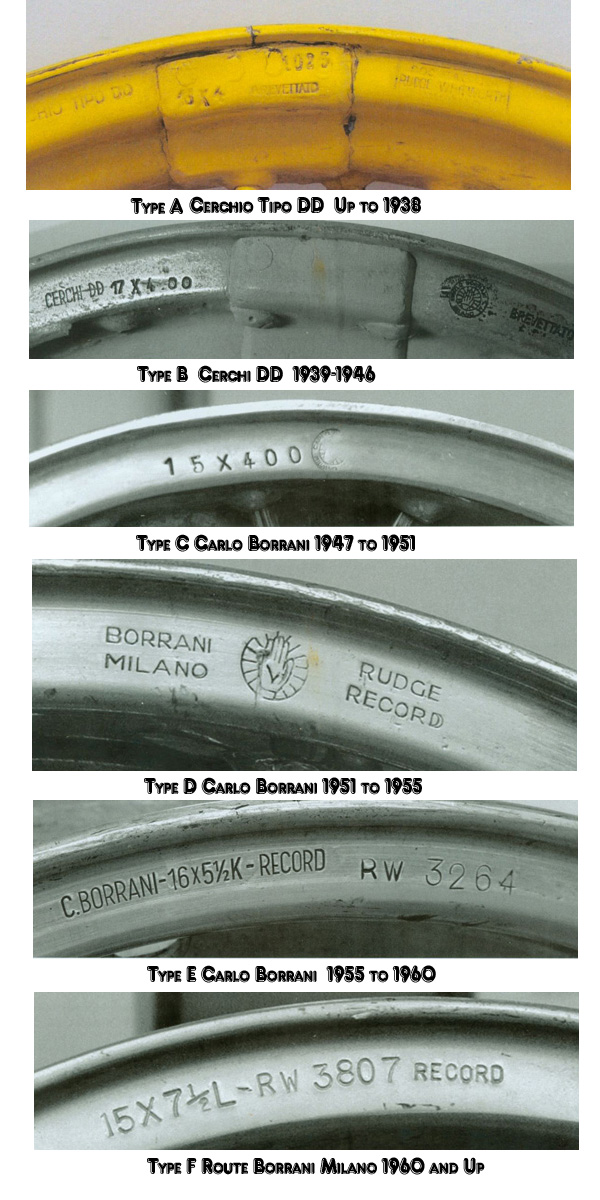
Borrani Historical Stampings
Borrani’s support of the new Ferrari marque was marked by the 1949 Ferrari Yearbook. Not only were Borrani wire wheels used on all race car applications but the street cars as well. Borrani provided the use of disc wheels called CABO Sport that had a riveted steel center with an aluminum rim. The design led to the development of the famous ‘bi metallic’ Borrani disc wheels in the mid 1950s.

The post war era was an exceptional period when a full 10% of the production of Borrani wheels was devoted to Ferrari. By 1955 the production of Borrani wheels rose to over 1500 per month, which forced the firm to build a new production facility. At the same time the company name was changed to “CRM-Rho Mechanical Engineering SpA. But the production of wire wheels continued to be linked with the brand Borrani Milan. Borrani also became famous as the official supplier of motorcycle wheels for Benelli, Gilera, Guzzi and MV Agusta.
Ferrari was no doubt proud of the inherent strength of the Borrrani wire wheel. In an age of horrendous and common racing accidents, very few were the result of wire wheel failure—notable exceptions being Ascari’s Ferrari wheel shearing at Indy in 1952, and Wilbur Shaw’s wheel collapsing during the 1941 Indy 500 (a faulty wheel had accidentally been put on the car). After the failure of Ascari’s Borrani wheel hub at Indy, according to Borrani literature, Ferrari appeared at the Borrani workshop “not exactly for a courtesy visit.” Borrani engineers defended their product, but Ferrari challenged the engineers to create the perfect racing wheel. “For the first time in the history of racing, Borrani produces the pieces from a solid block rather than the traditional sheet metal forming.”
Yes, those beautiful three eared knock-offs were inspired by Halibrand. They do make for an easier target though. Photo by Richard Prince.
Those beautiful three-eared knockoffs so prominent on the 1962 GTO were actually invented by U.S. engineer Ted Halibrand for use with his alloy Indy car wheels and appeared at the Speedway in the early 1950s. When Ferrari engineer Aurelio Lampredi went to Indy in 1952 to look after the Ascari Ferrari, he made note of the Halibrand three-eared knockoffs and after 1953, most racing Ferraris were equipped with the three eared nuts, aside from a few of the front wheels on the Lancia Ferrari D50. (Page 82,”Ferrari 1947-1997”, Rizzoli.)
At the factory today, a Borrani craftsman makes final adjustments on a classic wire wheel. Photo by Roberto Motta.
The last appearance of wire wheels on a F1 car at a major Grand Prix was on September 17th, 1962 at Monza, where five sharknosed 156 Ferraris line up on the grid. After the event, Ferrari temporarily retired from Grand Prix racing and missed the last three events of the season. When the cars from Maranello appeared again at the non Championship International Grand Prix at Silverstone on May 11th, 1963, the wire wheels had been replaced with a spidery alloy wheel with a large three-eared knockoff hub.
At the same time, the races became shorter, tire technology improved and the cars were a lot lighter; quick tire changes were rarely necessary. For a few years, the knock off hub disappeared as well. While Ferrari adopted alloy wheels with large three-eared knock off hubs for the 1963 race season, by the mid season Nurburgring Surtees’ winning 156 was equipped with five bolt wheels which saved “in the order of 4 lbs unsprung weight on each corner,” according to Surtees. (Page 138 John Surtees, World Champion, Hazleton Publishing 1991)
The era of the wire wheel in Formula One was over; sports car racing would follow but only after several more years. For Ferrari, again the holdout, the Borrani shod 250LM would give way to the magnesium wheeled 275 P2 and 330 P2 in late 1965. On the street, things were also grim for wires. The look of things to come at Ferrari came with the introduction of the 1964 Ferrari 275GTB—the first Ferrari to use modern alloy rims with central locking hubs. Borrani center lock wheels would be available as options through the 400 Automatic in 1976, but the standard Ferraris (aside from the high end F40s, Challenge cars, F50 etc) would now use a five bolt alloy wheel.


Kia Australia has a range of


{ 5 comments… read them below or add one }
Hi Pete,
When I ordered my 275/GTB.4 I ordered the “standard” Campagnolo wheels(there was no difference in price) but when the car was ready for delivery it was fitted with the chrome Borranis. When I “corrected” them, I was told that “ALL Americans want Borranis”. I replied,” Not after you’ve had several sets of them; but I want the Borrani hub nuts with the ‘Campi’ wheels.” They now KNEW I was crazy (“nuts” for bad pun) until I explained that the Campi (two-eared) nuts had radial ears, the Borrani (three-eared) had swept ears so the stupid Americans knew which side to hit with the hammer. This satisfied them and the car was so fitted.
Unfortunately,subsequent owners reverted to the Borranis, compromising the car’s uniqueness.
Ciao!
Dick
Great article.
I was in Grandstand H at the 1952 Indy and remember seeing
the spokes fly on the right rear wheel as Ascari came round turn 4.
Not a pretty sight and it’s easy to understand Ferrari being upset.
Wire wheels on a hipo racing car, function as an additional “flexible”
suspension component. (whether you like it or not:)
Open the shipping box, tear away the protective covering, lift out the brand new Borrani and take it out into the sunshine. Nothing else comes close!
What is your opinion of Campagnolo wheels? Still have originals on my Alfa.
I would like to replay to Al Axelrod… are you sure about your statement:”remember seeing the spokes fly…” ? Personally i do have a bit of experience on racing on Borranis and taking a close look at the construction of them i will say: considering that a spoke is basically an hook retained in the centre-piece, at the breaking moment i will say that the head with what is remaining of the shaft will be remaining attached to the centre-piece as lose rotating mass, i find very difficult that part launced as flying spoke… again the other , always theorically, half of broken spoke will have no choice to fly away being locked into the rim … unless the tyre collapses and separate from rim, then you may have a chance. A featuring of this event is very well described on Speed age july 1952, good article to read! The elasticity (to be more precise) is the best feature of a wire wheel, Borrani or not, makes dissipate the side forces, if it won’t it will brake…
So… don’t get mad of me… are you totally sure of it? it is not and additional “Fexible” suspension component sorry about that too…