$(document).ready(function() { $('a[rel="external"]').click( function() { window.open( $(this).attr('href') ); return false; }); });

Roland Garros/Black Bess Bugatti Part 3: Ivy Cummings

by pete on January 24, 2013

The Garros/Black Bess Bugatti crosses the Channel to a new life and legend.

By Gijsbert-Paul Berk

In its 100-year history, the Rolland Garros Bugatti had a number of significant owners, who together have accumulated an impressive amount of victories, often against competitors in more modern cars.

After the death of Roland Garros in 1918, the Bugatti became the property of Louis Coatalen, then Chief Engineer of the Sunbeam Motor Company Ltd. in Wolverhampton. During World War I he had designed the Sunbeam aircraft engines. In 1919 he was involved in the merger of Sunbeam with Talbot and Darracq to form STD Motors.

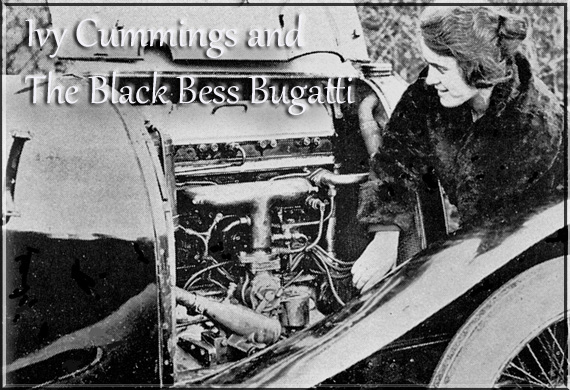
As Coatalen was born in Concarneau (Brittany) he spoke fluent French and was often in Paris. As a driver and an engineer he was greatly interested in fast and sporting cars. Sometime later –between 1919 and 1921- the Bugatti was bought by Sidney Cummings, a car dealer at Fulham Road, for his daughter Ivy.
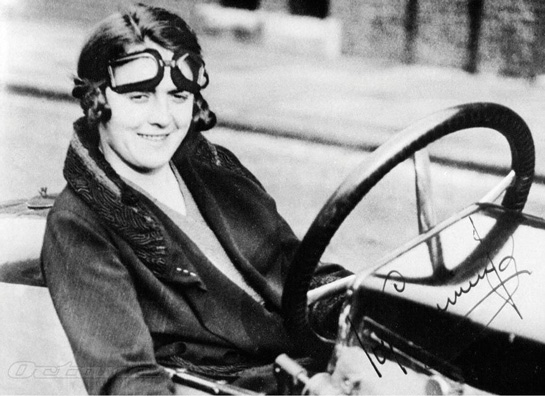
Miss Ivy Cummings. Photo courtesy Octane.

Ivy Cummings
Ivy (Leona) Cummings was born in London on October 27th 1900. She began her ‘racing career’ at the early age of 11. While at a visit to Brooklands, Sydney was occupied watching the aircraft. As the legend goes, Ivy took the opportunity to start the engine of his car and nearly completed a lap of the steeply banked track unnoticed. When she became 18, she started her legitimate racing career. At that time she also helped in the family business, and soon ran their garage at Putney Bridge Road, London. There she sold second-hand cars but often acted as a mechanic as well. Miss Ivy, as she was called, participated in competitions in a number of cars; a GN ‘Akela’, a Vauxhall 30/98, a Frazer Nash, a Sunbeam, a Bugatti Brescia and of course the five-liter ex-Roland Garros, ex-Louis Coatalen Bugatti that she christened ‘Black Bess’, after the black stallion described in a popular book about the notorious highwayman Dick Turpin.

Black Bess in competition
She used the 5 liter Bugatti in speed events and hillclimbs, achieving several class wins and records. In 1921 she participated with it in a race on the sands at Skegness – being the only women driver. The next year she took her Sunbeam to Brooklands and won the Duke of York Long Distance Handicap. Handing her the prize The Duke of York congratulated her for her driving style. Among her victories with Black Bess were the Bexhill Speed trials, the Sexton Hill climb near Scarborough and the Middlesex County Hill Climb. Driving a Bugatti T37, she led the 1926 Grand Prix de Boulogne (France) for the first three laps, before turning it over in a ditch on lap four – the three laps accounted for a quarter of the 448 kilometer race. Between 1919 and 1927 Ivy was a well-known and respected woman driver in the British world of motor sports.

After Ivy Cummings married Dr. Henry Warren-Collins, a radiologist, he persuaded her to give up racing. Ivy Cummings died on December 4th, 1971 in London.

Black Bess competing at Kop Hill in 1923.

Because the RAC in 1925 banned speed trials on public roads, Ivy Cummings had sold Black Bess to L. H. Preston, who studied at Oxford. He raced the Bugatti the same year at Brooklands and lapped there with an average speed of 90.06 mph. (144.90 km/h), confirming the car’s potential of 100 mph. It is believed that the famous journalist and race driver S.H. (Sammy) Davis also drove the car once or twice at speed events when Preston owned it.

Almost lost
Around 1931 the car was bought by James Robertson Justice, (1907-1975) then a journalist at Reuters, but later a popular film actor. It seems that Robertson Justice, who had raced before, planned to compete in it himself. But, as he soon discovered, the Bugatti needed a comprehensive restoration. The engine and especially the gearbox showed signs of heavy use during strenuous competition. So before he left to work for an indeterminate period in Canada, he took the car to the workshop of McEvoys at Derby. This specialist had an excellent reputation for building and restoring racing cars. However, McEvoys was himself busy and the Bugatti languished in a corner of his workshop.

Black Bess as found by Bill Boddy in 1933.

There it remained until 1933, when William Boddy (1913-2011) – a young journalist who worked for Motor Sport and later became its editor – discovered the Bugatti in its original but rather neglected condition in the McEvoys’ garage at Derby.

Boddy wrote an article for Bugantics , the club magazine of the Bugatti Owners Club and persuaded Colonel G. M. Giles, then Vice President of the BOC, that this historic car should be rescued and brought back to its former glory. Giles bought the Bugatti and during the year 1935 it underwent a rigorous restoration. Wherever possible the original parts were reconditioned.

Black Bess, circa 1939 after the Bertelli restoration.

Rebirth and the BOC
The engine and transmission were overhauled, the friction shock absorbers replaced, the electric circuit rewired and additional dashboard instruments were fitted as well. The body was rebuilt by Bertelli of Aston Martin fame. The car was discovered in Derby missing its front fenders and lacking photos of the original Labourdette coachwork; Bertelli made new ones in the style that was popular on other Edwardian cars. After the work was finished the Colonel and his brother Eric, who was also a Bugatti aficionado, regularly drove Black Bess in meetings of the Bugatti Club, the VSCC and other events.

In 1938, with WW II approaching, Colonel Giles sold the Bugatti to Rodney Clarke. The price was £200 and included a spare engine and second chassis (that was later to be used to recreate the ‘third’ surviving Type 18). Clarke was a great Bugatti fan and had previously owned a Bugatti Grand Prix Type 59. He participated with Black Bess in many historic races and managed to be rather successful, sometimes even against competitors in cars with larger engines such as the 12 liter Itala of Cecil Clutton and the 10 liter Fiat of Anthony Heal. Clarke kept Black Bess until ill health caused him to search for someone else who would take good care of his prized possession.

Rodney Clarke in 1946 with Black Bess in the rain.

Peter Hampton
In April 1948 the late Peter Hampton, who already had an impressive number of early Bugattis, added Bess to his stable for £400. Two weeks later he drove it to the French Grand Prix at Reims and it ran faultlessly. But Hampton was a perfectionist. In his luxurious workshop at Spronketts, he removed the engine and sent it out for a complete overhaul. All the other parts were carefully checked and if necessary reconditioned. Hampton, who had been wounded during the war in the arm, also modified the brake system so it could he operate it with his foot instead of the hand lever, and fitted an electric starter motor.

Peter Hampton at Prescott,1951.

David Heimann
Hampton cherished the car and took it regularly to historic car meetings. Forty years later in 1988, David Heimann, another Bugatti enthusiast and collector of historic racing cars acquired Black Bess. He had the car meticulously prepared by the renowned Bugatti ‘magician’ Ivan Dutton. Heimann continued to participate with it in various competitions. One of his heroic achievements was to achieve pole position (fastest practice time) for the 1991 Edwardian race at Mallory Park. Unfortunately brake problems forced Black Bess to be contend with fifth place. The winner was a 1908 12 liter Grand Prix Itala. By now the Bugatti was again equipped with fenders similar to the ones Labourdette had fashioned for Roland Garros’s car in 1913, but during race meetings these fenders were of course removed.

David Heimann was the last owner of Black Bess drive it in competition. The fenders were removed for racing.

After another twenty one years, Black Bess was again on the market. In 2009 Bonhams presented it at the Rétromobile show for their yearly auction in Paris. It was estimated to fetch around €1.600.000. However, Bonhams sold the Roland Garros Bugatti for €2.427,500 ($3,131,475.), including the buyer’s premium and VAT. It now resides in the Louwman Museum at The Hague, Netherlands.

Sources:
Much of Garros’s life story was translated from a French article titled: ‘Une enfance au soleil’, at http://wikipedia.orange.fr/wiki/Roland_Garros
In 1993 Aries Press Ltd. in the UK published the book: Black Bess, History of an Edwardian Bugatti. It was written by William B. (Bill) Boddy, who in 1933 rescued the car, and edited by Barbara Cowen. Some of the history about the fabulous Bugatti in this article is derived from the brochure that Bonhams prepared for their 2009 auction and that text was based on the book. ISBN: 0951178512 & 9780951178515. Unfortunately the book is now out of print.
Other sources were L’épopée Bugatti by Ebé Bugatti
It was first published in 1966 by Editions de la Table Ronde,
and in 1211 republished by Editions du Palmier.
http://www.editions-palmier.com & contact@editions-palmier.com.
It only exits in the French language.

Videos

http://www.britishpathe.com/video/another-win-for-the-ladies/query/Ivy

http://www.britishpathe.com/video/sporting-eves-miss-ivy-cummins-the-racing-motorist

http://www.britishpathe.com/video/stills/brooklands-by-the-sea-tinted

{ 5 comments… read them below or add one }

Michel Van Peel January 25, 2013 at 5:30 am

Thanks for a well researched article;l’Epopée Bugatti was in fact translated into English by Len Ortzen as early as 1967 under the title The Bugatti story,published by Souvenir Press.And Ettore’s daughter was called l’Ebé with the article l’.
Keep up the good work.
Regards,
Michel Van Peel

pete January 26, 2013 at 12:13 pm

Gijsbert-Paul replies: Michel Van Peel is right of course. Indeed, Ettore in 1903 christened his first child (a daughter) l’Ebé (his own initials) Maria Teresa. In 1907 he married her mother Barbara and they had their second daughter Lidia. And indeed again, the book l’Ebé wrote as L’épopée Bugatti“ (La Table Ronde – 1966) was in 1967 translated into English by Len Ortzen and published as “The Bugatti Story”. To make matters a bit complicated William (Bill) Boddy also wrote a book called “The Bugatti Story” published in 1960 by Sports Car Press. Both books are out of print for some time, but second hand copies are still sometimes offered for sale on internet at Amazon and Abebooks or Priceminister. Our thanks to Michel.

Mary Ann Dickinson January 27, 2013 at 9:30 am

Wonderful reading about Ivy Cummings and Black Bess. It is always amazing to me how many avid women racers there were in the first 50 years of the twentieth century versus how few there are in the first 12 years of this one. It is a testament to how racing has changed over the years– and not for the better!

Dick Ploeg February 3, 2013 at 7:04 pm

A commendable effort to summarise the important lives of Roland Garros and Black Bess!
One comment I should like to make is that Roland Garros did not pioneer a synchronised machine-gun firing system. As is also visible in the accompanying photograph in the article he used armoured deflectors on the propellor blades to protect the propellor blades from being damaged by the bullets. After Garros had a forced landing behind the enemy lines, on April 18, 1915, the Germans furnished te captured plane to Fokker for study. This inspired Anthony Fokker to his synchronising mechanism, which interrupts the fire when a propellor blade is in its way. This synchronising mechanism was first used on a Fokker plane in September 1915. Nonetheless even Fokker was not the first to invent a synchronising mechanism for machine-guns, but merely the first to get it reduced to practise.
As regards the fenders put on Black Bess when restored by Bertelli were not newly made, but reputedly were sourced from a Harrington bodied Bugatti. These particular fenders were probably adapted to Black Bess on the directions of Eric Giles, the younger brother of Col. Geoffrey Giles. Eric Giles was a great designer in its own right and he made some awsome designs for the type 57 and type 57S Bugatti’s that they bought new. Not surprisingly Eric Giles had done an apprenticeship with a coachbuilding firm and was a home interior designer by profession. It may be given some thought that fenders that were already more then 60 years old in the 1990’s were replaced by completely new ones that immitate the lost original Labourdette fenders.

George Graham March 30, 2013 at 6:49 pm

Ivy Cummings was my Great-Grandmother. It’s very nice to see a photograph of her.

Leave a Comment

Previous post:

Next post: