$(document).ready(function() { $('a[rel="external"]').click( function() { window.open( $(this).attr('href') ); return false; }); });

Iso Rivolta Four Passenger Vintage Racer

by pete on February 9, 2011

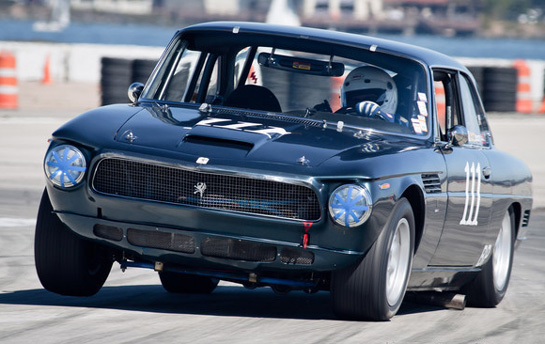
Peter Whitehead hustles his four-seat racer through a turn. Photo by Racecarshot.com.

By Brian Winer

You would think, in a country like Italy, that once seeing Ferrari V12s or Maserati V8s in action, any Italians thinking of building high performance cars to compete with them would throw up their hands and say “It is useless to compete—you cannot improve upon perfection.”


And then there were guys like Renzo Rivolta who, after venturing from the refrigerator making business into cars with the tiny BMW Isetta in the fifties, decided to make a grand touring coupe.

Not using an Italian engine, of great complexity and cost, but an off the shelf Chevy V8 with an iron block, iron heads, overhead valves, low tech but high horsepower.

The result? A four seater coupe that can be out there on the same race course as a Ferrari or Maserati four-seater and blow their doors off. And if you live in the U.S. and blow a part, hey, you stop at Auto Zone or the nearest junkyard. Try that with your Ferrari or Maser.

The first Rivolta was shown in the Turin show in 1962. If you dig into its history you find that it actually was a phoenix arising out of the ashes of a British project called the Gordon Keeble.

The Gordon Keeble was an ambitious project, borne from a previous car called the Peerless. It had a one inch square tube space-frame, a De Dion rear axle and all round disc brakes to cope with the 290 bhp(gross) at 6250rpm provided by the 4.6 liter Chevrolet V8 engine.

Timeless design. The Iso Rivolta did well for the new company and no doubt the lines helped.

They went to the right folks, Carrozzeria Bertone, whose head designer was the youthful and inventive Giorgetto Giugiaro. The prototype was built with aluminum coachwork and the car made its debut on the Bertone stand at the Geneva Motor Show in March 1960. The plan was to build them in fiberglass and market them against the Jaguar four seaters.

John Gordon thought he had a real winner and he even took it to Detroit where he got promises from their resident gearheads, Chevrolet President Ed Cole and Corvette chief engineer Zora Arkus Duntov, that Corvette engines would be made available for the project.

But then, as often happens, things go wrong, the car was way higher priced than the Jags it competed against and less than a hundred were made.
But Renzo Rivolta couldn’t see this idea dying. He decided to commission his own four-seater coupe along similar lines, hiring the same design firm to do his version.

The engineer of Rivolta’s version was none other than Giotto Bizzarrini. To sum up this man’s skills, one need only say “GTO” for it was while he was with Ferrari that Ing. Bizzarrini engineered the immortal Ferrari 250GTO.

The Rivolta borrowed a lot of engineering ideas from the Jags of the time, notably the four wheel discs and de Dion rear suspension.

The model succeeded, but the Iso company only lasted about ten years as an automaker.

Sporting 60s interior still sparkes.

Four Seater Race Car
Nearly half a century later, a new believer in the philosophy that cheap power is good power is Californian Peter Whitehead.

He found this 1964 model Iso Rivolta in Australia in 2005. He found that it had some racing history in both California and Australia so decided to further race prep it.

First there was that 327 engine. Originally you could get it in a Rivolta with 300, 340 or 350 hp. But that was then. This is now. Who better to take it to than fellow vintage racer Vic Edelbrock, whose business has equipped thousands of hot rodders with intake manifolds. At Edelbrocks it was equipped with an era-correct intake manifold and a Holley four barrel carb. Other engine mods included high compression pistons, a high revving flat tappet cam, ported era-correct heads and headers. It now cranks out about 450 hp.

Edelbrock fixed up the Chevy with era correct carbs and intakes.

In the stock Rivolta you could order a Borg-Warner T-10 four speed manual and this one has that, but Whitehead upgraded to stiffer springs, Koni shocks, and Minilite mags which may not be what was raced on the handful of other racing Rivoltas but were proven in American Trans Am competition on the Boss 302s and other T/A cars. The wheels are 7” x 15” and run Goodyear Sports Car Specials, sized 6.00” x 15” all the way around.

The car came with a huge 25 gallon gas tank, which means he can run longer in an endurance event than most drivers.

Whitehead felt a little odd driving a four seater in racing against two seaters but points out that there are a few other four seaters in vintage racing including Mustangs, BMWs, Alfa Romeos and the Jaguar 3.8 sedans.

How does he account for the fact that it’s a four seater Iso competing in vintage racing in America when one would think it would be the more svelte Iso Grifos that would be representing the brand on America’s racetracks?

He says part of it is that there was a predecessor, a Rivolta prepared by the factory for racing and run in the 1968 LeMans event. It is now part of the collection of Piero Rivolta, son of Renzo Rivolta, who is a boat builder and real estate developer in Sarasota, Florida. “There are half a dozen Rivoltas racing in Europe,” Whitehead says. The Le Mans Iso, driven by De Mortemart/Fraissinet, actually finished 9th overall, behind the Cobra of Sears and Thompson. Not bad for a four-seater.

Whitehead’s car, which weighs under 3000 lbs. even with its steel body, scoots. “In stock form it would go 0-60 mph in 6.5 seconds and reach 145 mph,” says Whitehead. As it is now in race trim with either the four barrel Holley or a quartet of sidedraft Webers and a hot cam, he thinks it could reach 165 mph.

Strangely enough, there are few Iso Rivoltas competing in vintage racing Stateside. Given the low cost and high performance, this is not likely to be the case for long.

{ 10 comments… read them below or add one }

Yale February 9, 2011 at 2:58 pm

They made 99 Gorden Keebles, (not less then a dozen).

Chris Smith February 9, 2011 at 4:32 pm

I’m in Sydney in Australia,where I compete in Sportscar Racing.I think this Iso was Graham Smith’s who Raced it in Victoria in Australia a few years back.He’s a perfectionist as Whitehead appears to be.And,I also think it ran in Group S Sportscars.I raced a Ford 289 Powered TVR Griffith at the time.The Griffith was a bit quicker so had a more success especially at Phillip Island.Frankly,I wish I hadn’t sold it. I bought it from GrandPrix Classics of La Jolla,Mark Leonard,in 1999,and it was great example.As described,thanks Mark.I competed in 53 Races all over the East Coast and it won 47. Not bad for a glass fibre “Kit” Car!!
Then I sold that back to the ‘States,to Larry Ewart in Phoenix

Dale409 February 9, 2011 at 4:51 pm

Yale, I’m not sure where the ‘less than a dozen’ came from. The article actually says Gordon Keeble made less than 100 cars and 99 fits into that description.

pete February 9, 2011 at 4:55 pm

All,

Your editor is quick. I made the changes as suggested by Yale. Sorry about that but it’s better to get the record straight right away.

Ed.

Reg J Lowe Esq February 10, 2011 at 4:29 am

A very interesting article. One doesn’t read very much about Iso and this made a refreshing change.

Robb Northrup February 10, 2011 at 11:36 am

Very nice article. For those interested in greater detail, see Winston Goodfellow’s excellent book “Iso – The Men, The Machines.”

Regarding the Gordon Keeble: It was not really a development of the Peerless. The project began with a request for a V-8 Peerless for racing by Capt. Rick Nielsen, USAF stationed in the UK. Nielsen had been racing a ‘58 Corvette, courtesy of GM, and Nielsen brought in his race engineer, Jim Keeble to handle the conversion. And truly one thing led to another as all parties saw potential for a completely new, upscale car. Jim Keeble designed the entire chassis and utlized suspension component from various British suppliers. Jim confirmed all this in an interview at his UK home 11 years ago.

The Gordon Keeble was Giugiaro’s first real assignment at Bertone!

Originally called the Gordon GT, the intent was to have bodies built in metal by Bertone. But the money was never there, which caused a major delay while Gordon sought investors. Cost was the reason why they went with fiberglass (glassfibre!) and by the time the “Gordon Keeble” was launched, the price had risen to a point where the value just wasn’t there.

It’s a fantastic car, though, and an excellent “driver.” But with a much different feel than the Iso.

Robb Northrup February 10, 2011 at 11:42 am

Sorry to nit pik…

The Gordon GT was the inspiration for Renzo Rivolta, who was looking to building something grander than the Isettas and scooters he’d been selling.

He saw the Gordon at Bertone’s and brought in Bizzarrini to evaluate it. While Jags had 4-wheel disc brakes, none ever had a de Dion rear. That came from the Gordon.

The Iso was developed at the same time as Gordon was looking for financing, and actually its launch pre-dated the relaunch of the Gordon in the UK. The Gordon died several years later.

Nicholas February 11, 2011 at 8:51 pm

The Rivolta has always been a favorite of mine. When you come across any Giugiaro design, you just have to stop and appreciate it. The man is truly gifted.

Darren Frank February 12, 2011 at 11:48 am

The LeMans Rivolta was actually a 1968 model, not a 1965. It was prepared to race at LeMans, but crashed during qualifying. It was photographed in the day racing at Monza, but did not finish or place at LeMans.

Pete Whitehead February 12, 2011 at 12:33 pm

Nice article Pete and thanks. Just a couple minor corrections that we missed:
The Le Mans Rivolta was entered in the 1968 race, and did not start due to a serious crash in practice, and the Iso that finished 9th overall was an Iso Grifo A3C, a two seater. Also, yes this is Graham’s old race car, and I must thank him for a great car.

Leave a Comment

Previous post:

Next post: