$(document).ready(function() { $('a[rel="external"]').click( function() { window.open( $(this).attr('href') ); return false; }); });

The Exner Renwal Revival Cars of 1964

by Brandy on February 7, 2013

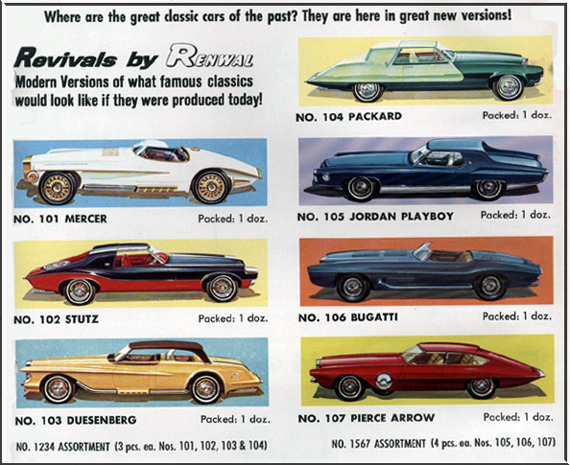
Catalog courtesy Peter Larsen.

By Brandes Elitch
Photos courtesy of http://www.madle.org/

If you were a teenager in the 1960’s, as I was, you will remember that Renwal made a series of plastic 1/25 scale model car kits of the Revival Cars. Renwal Products was located in Mineola, NY. I have the ’66 Packard model. The box art says, “Modern Version of a Great Classic Car-Advance Showing.” There was even a slot car version, at least according to the assembly instructions. This is the story behind the Exner Revival cars.

In December of 1963 Esquire magazine published an article under the heading “Flights of Fancy.” It was titled “Introducing the 1964 Duesenberg, Packard, Stutz, and Mercer!” and written by Diana Bartley. It describes how the concept of the Exner Revival Classics, in particular the Mercer, Bugatti and Duesenberg designed by Exner with bodies constructed by Ghia and Sibona & Basano was brought to Exner.

Bartley sets the stage:

“Granted that American car design now ranges from acceptable to handsome, still, one of the ways our cars aren’t better than they used to be is that they all tend to look alike…anyone familiar with the individuality of so many of the great American cars of the past does notice – and cares.”

Bartley, who was a well-known automotive writer in the fifties and sixties, was one who cared. More than that, she had a notion and the opportunity to do something about it. She contacted Virgil Exner, recently retired VP of Styling at Chrysler. Exner and his son had a design consultancy business. Bartley broached the idea to them of creating sketches of a “modern parallel” to the great American cars which had what she called “immense marque identity,” but which no longer existed.

Choosing to work with the Exners was a stroke of genius for Bartley. As she relates, “…the Exners still believe that luxury-car buyers would welcome a return to the wide choice of luxury-car makes and models that was available almost until WWII.”

Exner Sr. commented, “We believe not only that greater stress should be put on the development and continuous refinement of a distinctive character for each marque, but also that the market for luxury cars can be greatly stimulated by some real effort to recapture some of the elegance and originality which make many of the old cars so interesting and exciting to us yet today.”

Bartley further comments, “You might think that the Exners are the theorizers…But they are more than that. They’re the doers.” Responding to her guidance, they actually produced four modern versions of the cars in the title for 1964. In creating the cars, Exner assumed that “… each manufacturer had pursued a policy of refinement and modernization of the cars’ identifying characteristics, and that each had decided to resume business after a thirty year lapse. What we are trying to do is to capture the spirit of the older car design and body type in a modern package.”

In the article, the Exners provided pencil sketches of the original cars and their modern version. There were four pencil sketches of each car, two of the front and two of the rear three-quarter views, along with their informative commentary. Above this was a 7-8 inch color rendering of the side view of each car.

Bugatti T101
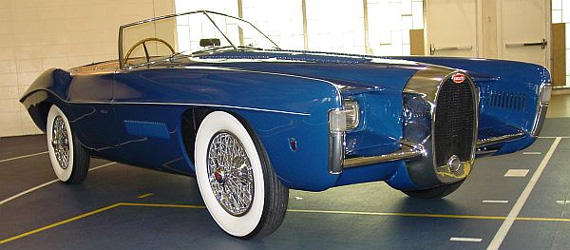
The Exner Bugatti Revival on a T101 chassis. Now with General William Lyon.

Bartley concluded by noting that the Exners had been asked to build a full scale functioning prototype of at least one of these designs. Indeed, there were three cars built. The first was on the last Bugatti Type 101 chassis, bodied by Ghia and shown at the Turin Motor Show in 1965. To describe this, it is necessary to quote from the book, Virgil Exner, Visioneer, by Peter Grist (2007, Veloce Publishing, Dorchester, England). Grist describes how Exner came to own the last Bugatti chassis: “When Exner and Junior arrived…they found a rundown house and a large barn. They were shown around by the housekeeper who, on opening the barn doors, revealed a line of 14 unrestored Bugattis…The Type 101 chassis was fitted with a supercharged engine and a box seat, so it could be driven. Exner purchased the chassis for $2500, and a month later, Junior, along with his best friend, Mike Cleary, collected the chassis and trailered through winter blizzards back to Birmingham, MI…One month later, Junior returned to Perth Amboy and bought the Galibier bodied Type 57 for just $1500, driving it all the way home.”

Exner and Junior immediately set out to produce a Revival Car design. They built a small 1/8th scale clay model, helped by Paul Farago and Dale Cooper. It happened that Ghia still owed the Exners $27k in unpaid design consultancy fees, so they came to an agreement whereby Ghia would build and ship the car and the debt would be forgiven.

I actually saw the Exner Bugatti about twenty years ago, when the Classic Car Club of America had their annual meeting in Orange County, CA. Part of the fabulous weekend was a bus trip to the home of General William Lyons, where we were treated to a tour of his garage. The car was there, and it was truly as exciting and desirable as any Bugatti of the thirties; a masterpiece, in my opinion. (Lyons has both the Exner Mercer and Bugatti in his collection).

Duesenberg Chrysler

Exner's sketch of the Duesenberg Revival.

Next, the Exners met with Fritz Duesenberg, the son of August Duesenberg. Fritz wanted to build a modern version of his father’s car and found the right team in Exner and Ghia. Ghia had just finished building ten Crown Imperial limousines for the 1965 model year, and they were quite knowledgeable about working with the Imperial chassis, arguably the finest American luxury car chassis of the period. Ghia built one car at a reported cost of $60k, in 1965 dollars. If the car had gone into production in 1966, the suggested retail price was almost $20k, at a time when the Imperial LeBaron went for a third the price. The car made its public debut at the 1966 Indianapolis 500, where it was warmly received. Everything seemed to be on track, but then at the last minute, the major financial backer, one Fred J. McManis, Jr. pulled out, and the project never recovered. I saw this car displayed in the ACD Museum in Auburn, IN, in 1972. It was spectacular, and is just as spectacular today.

Mercer Cobra

As sketched by Exner, the Mercer Revival had a racing windscreen wrapping around the cockpit with no provision for a convertible top. The headlights popped out of the body side when needed. The car had dual sidepipes similar to those seen on one or two small block Cobras used in racing. Another feature of the car was scoop-like vents behind the rear wheels similar to those on the Pininfarina-designed Ferrari Superfast. --Wallace Wyss

And this brings us to the Mercer Cobra. To quote from the original Esquire article: “The Mercer Raceabout was produced from 1911-15, the most famous of all Mercers…the 1964 version remains without any top and with the briefest windshield, has modern flush sides, but is quite narrow, giving small frontal area. The Exners have not designed a ’64 Mercer racing car, but instead a big, fast, comfortable road car, a lean, powerful machine, with emphasis on mechanical beauty. Toward this end, they eschewed full envelope streamlining of race cars for an unusual exposure of mechanical parts. Rear end of new model clearly follows the idea of extremely flared rear fenders and prominent gas tank cap. Front end styling was inspired by the later, 1916-22 model. Wheelbase is about 110 inches, wheels a fully 17 inch diameter.”

The Real Machine, a 1911 Mercer Raceabout, one of America’s first sports cars. Elitch photo.

One of the people who read the original Esquire article was one George Hartley, President of the Copper Development Association. He envisioned a car build with brass and copper accents wherever possible, to encourage the industry to use more copper in their cars. By this time Ghia was experiencing some financial issues, but noted industrial designer Brooks Stevens advised the Exners to use another Italian coachbuilder: Sibona & Basano. Exner ordered a stock Cobra chassis, CSX 2451, AC pulled it off the line and sent it to Italy, and made a running, driving car. Extensive use was made of copper, with 11 different materials, alloys, and finishes. Automobile Quarterly did a six page feature of this car in their Winter 1964 edition. The CDA kept the car for a decade, and it was sold at auction in 2012 for an amount rumored to be $660k.

On the Mercer, as much copper as possible was featured, even using it as a material in the gauge bezels which look very much like Chrysler gauges of the last few years. The copper bezels were not functional but underneath the original Cobra gauges were kept. The various metals were finished in the best texture; some of the metals being bronze, some brass, some copper, in order to show the versatility available in each metal. –Wallace Wyss

While only three actual cars were built from Diana Bartley’s idea (not counting the Stutz versions, outside the scope of this article), I think we can call Bartley’s vision a success. Having spent my lifetime studying automotive design, I am tempted to write something contrasting Exner to his peers, Earl, Mitchell, Walker, and Engel, but I will not succumb to this temptation, at least not this time. Suffice to say that while all of these individuals were talented and famous, I believe that Exner was the best of the lot. He was a true artist, uniquely qualified. To learn more, I recommend A Century of Automotive Style, by Lamm and Holls, (1996, Lamm Morada Publishing, Stockton, CA), and The Art of American Car Design, by C. Edson Armi (1988, Penn State University Press, University Park, PA).

{ 2 comments… read them below or add one }

wallace wyss February 7, 2013 at 9:22 pm

Thanks for running this. I am trying to convince Ed. to do a story on the Stutz Blackhawks that came out of the Duesie revival car. One of the most delightful car designers I ever met was Virgil Exner Jr. while he was in Monterey to appear with a Ghia built show car his father designed. I asked him about different Detroit designers and he would imitate them. It was great! I wish back when I peeked in the window of their Woodward Ave. studio I would have had the nerve to knock on the door and meet him 30 years earlier!

John Slater February 10, 2013 at 7:26 pm

I have the Lamm and Holls and Exner books and I agree with the comment about the Exners. The Mercer Cobra toured Australia, I think it might have been ‘68 or ‘69. I think I still have a brochure I collected at either the Sydney Motor Show or Royal Easter Show. As a kid of 13 or so I was blown away, but I did worry about stone chips from those open fenders……..

Leave a Comment

Previous post:

Next post: